
If you’ve ever looked at a GIA diamond certificate or grading report for the first time, it can feel overwhelming.
Carat weight, colour, clarity, measurements, polish, symmetry, fluorescence, proportions — what does it all mean, and which details should you focus on?
A GIA report provides an independent assessment of a diamond’s characteristics and quality. Understanding the information in that report can help you make a much more informed decision when comparing diamonds.
While the grades matter, they are only part of the story.
Here’s how to read a GIA diamond report — and what we look at when helping our clients choose a diamond.
What Is a GIA Diamond Certificate?
Although you’ll often hear it called a GIA certificate, the correct term is a GIA Diamond Grading Report.
GIA — the Gemological Institute of America — independently examines diamonds and records their characteristics using established grading standards. A full GIA Diamond Grading Report includes the diamond’s shape, measurements, carat weight, colour, clarity, and, where applicable, cut grade, plus polish, symmetry, fluorescence, and other identifying information.
Importantly, GIA does not sell diamonds. Its role is to assess and document the diamond you submit.
🎯 Think of the report as the diamond’s independent record of identity and quality.
1. Start With the GIA Report Number
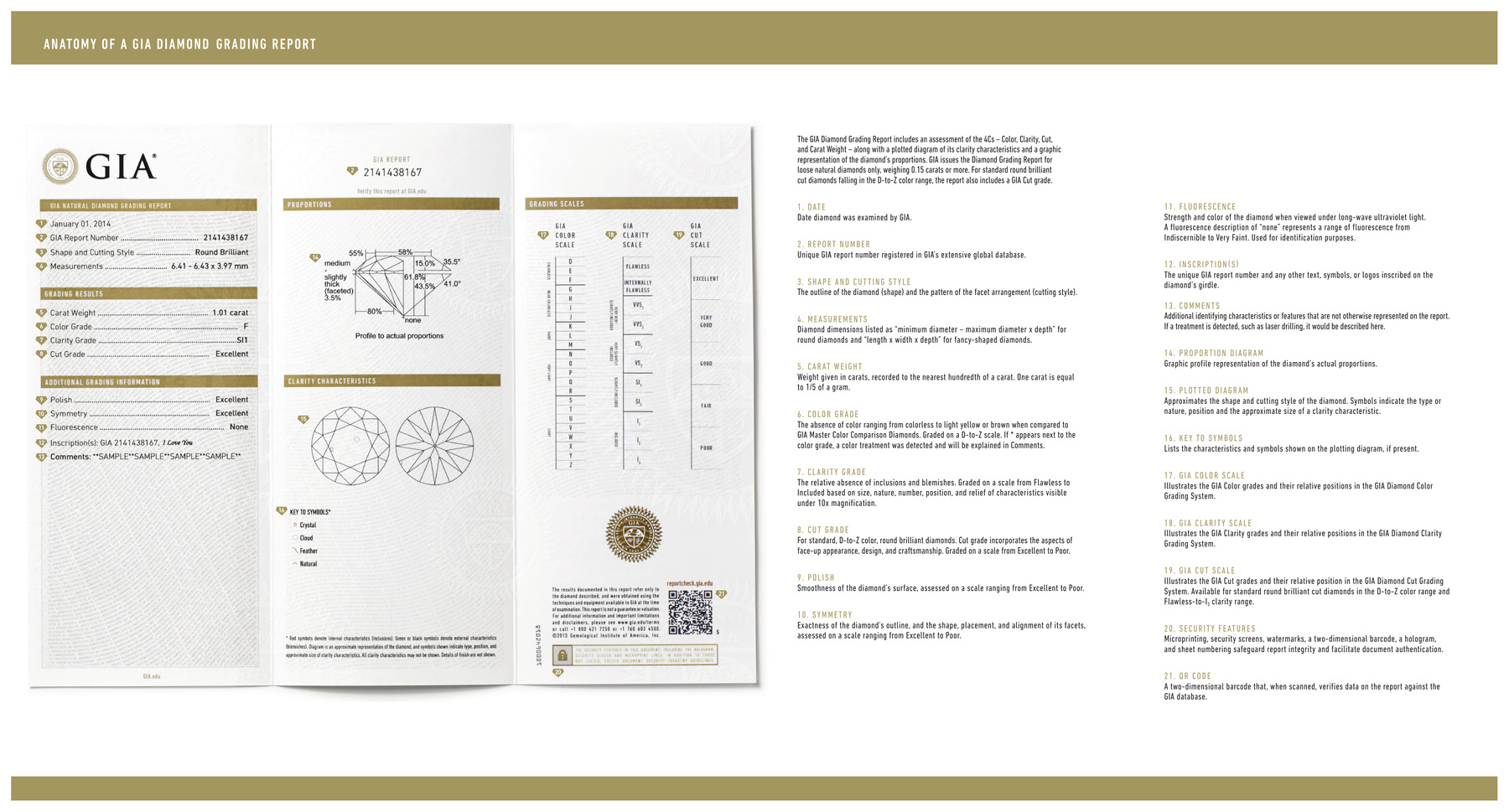
GIA assigns every diamond a unique report number.
This lets you match the grading information GIA holds to the report you’re looking at. GIA also provides an online Report Check service, allowing you to enter the report number and view the grading results held in its database.
A report may also list an inscription. When a GIA report number is laser-inscribed on the diamond, it appears microscopically on the girdle — the narrow outer edge of the diamond.
💡 Tip: When you’re considering a diamond with a GIA diamond certificate, checking its report number online is a quick and useful step.
2. Shape, Cutting Style & Measurements
Near the beginning of the report, you’ll find the diamond’s shape and cutting style, together with its measurements.
The shape describes the diamond’s outline — for example, round, oval, pear, emerald or marquise — while the cutting style relates to the arrangement of its facets.
The measurements tell you the diamond’s physical dimensions in millimetres.
This is more useful than it may seem at first.
Two diamonds can have the same carat weight but different dimensions and proportions, so they may not appear the same size when viewed from above.
💡 Tip: Carat tells you the weight. It doesn’t tell you everything about how large a diamond will look.
3. Understanding the 4Cs
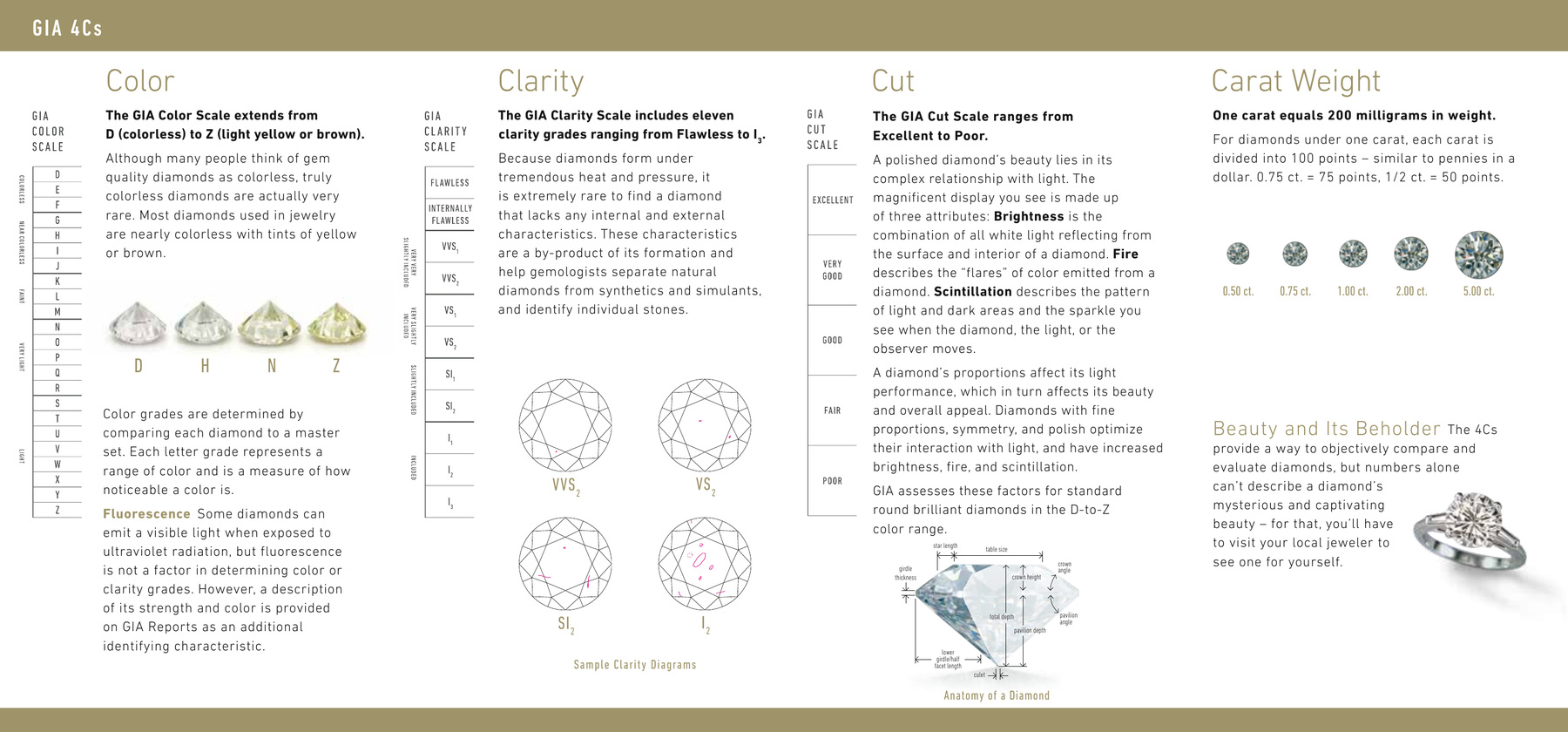
At the heart of the GIA report are the 4Cs: Cut, Colour, Clarity and Carat Weight.
These provide a standardised way to describe key aspects of diamond quality.
The 4Cs of Diamond Quality. Courtesy of GIA.
Cut
Cut describes how successfully a diamond’s proportions, design and craftsmanship allow it to interact with light.
For standard round brilliant diamonds in the D-to-Z colour range, GIA assigns an overall cut grade from Excellent to Poor. GIA does not currently give the same overall cut grade to fancy shapes such as oval, pear or emerald cuts. However, their reports still contain other useful information, including measurements, polish and symmetry.
Colour
For diamonds in the normal D-to-Z colour range, the scale begins at D, representing colourless, and progresses through increasing degrees of colour.
But a higher colour grade isn’t automatically the right choice for every piece of jewellery.
A slight warmth can work beautifully, particularly when setting a diamond in yellow or rose gold.
Clarity
Clarity assesses characteristics within and on the surface of a diamond.
GIA evaluates clarity under 10× magnification, considering factors including the nature, size, number, relief and position of those characteristics.
We often describe inclusions as being a little like a diamond’s fingerprint. They are part of what makes an individual diamond unique, and many aren’t visible to the naked eye.
Carat
Carat is a measurement of weight, not simply size.
This distinction matters because two diamonds with the same carat weight can have different proportions and face-up dimensions.
If you’d like to understand these four factors in more detail, our 4Cs of a Diamond guide explains each one and how they work together when choosing a diamond.
4. Don’t Overlook Polish & Symmetry
Further down the report, you’ll find polish and symmetry.
Polish assesses the condition and quality of the diamond’s facet surfaces, while symmetry looks at the precision of its outline and the placement and alignment of its facets. GIA grades both from Excellent through to Poor.
These details can be easy to skip when your attention is naturally drawn to colour, clarity, and carat weight.
But they’re part of the bigger picture when assessing how well a diamond has been cut and finished.
5. What Does Fluorescence Mean?
Fluorescence is another line on a GIA report that can sometimes cause unnecessary concern.
It describes the strength and colour of visible light a diamond may emit when exposed to long-wave ultraviolet light.
Fluorescence is not automatically a negative characteristic.
GIA says around 25–35% of diamonds submitted to it show some degree of fluorescence, and only a small proportion show fluorescence that noticeably affects their appearance.
This is another good example of why we wouldn’t judge a diamond based on a single line of its report.
6. Understanding the Proportion Diagram
The proportion diagram provides a side-profile representation of the diamond’s actual proportions.
Depending on the diamond and report, you’ll see information relating to features such as its table, total depth, girdle and culet.
These numbers can be useful when comparing diamonds, but you shouldn’t necessarily consider them individually.
A diamond is a three-dimensional object, and its proportions work together.
💡 Tip: This is one reason we prefer to assess the whole diamond rather than chase one supposedly perfect number.
7. The Clarity Plot — Your Diamond’s Fingerprint
On a full GIA Diamond Grading Report, you may see a diagram of the diamond showing its clarity characteristics.
Different symbols indicate the type, approximate size and position of characteristics found during grading. GIA’s key to symbols explains what each marking represents.
This diagram can look slightly alarming if you’ve never seen one before!
But remember: it is a technical grading diagram, not a picture of what you’ll necessarily see when you look at the diamond with your own eyes.
Some characteristics shown on a report may only be readily visible under magnification.
Because the combination and position of clarity characteristics can be unique to a particular diamond, the plot can also help identify it.
8. Read the Comments
The Comments section is small, but don’t automatically skip over it.
GIA uses this area for additional identifying characteristics or features that aren’t otherwise represented elsewhere on the report. If GIA detects certain treatments, it may also disclose them here.
It’s therefore worth reading the complete report rather than focusing solely on the large grades at the top.
9. Check Your GIA Diamond Certificate Online
If you have a GIA diamond certificate, you can check the report number and grading results directly through GIA Report Check.GIA Report Check.
This allows you to compare the information you’re looking at with GIA’s own database.
Check a GIA Diamond Grading Report
It’s a simple step, but one we’d always recommend when reviewing a GIA-graded diamond.
What a GIA Report Doesn’t Tell You
📌 This might be the most important part of this guide.
A grading report describes a diamond. It doesn’t choose one for you.
Two diamonds can look very similar on paper yet look different in person.
And the diamond with the highest grades isn’t automatically the diamond you’ll prefer.
Proportions, light performance, the position and visibility of inclusions, colour, shape and simply your own personal preference all contribute to how you respond to a diamond.
Even GIA advises buyers to look beyond the numbers and view diamonds in person before choosing.
That’s why, at Icecool Diamonds, we don’t believe choosing a diamond should become an exercise in finding the highest combination of letters and numbers on a report.
💡 Tip: The report helps us understand the diamond. Seeing the diamond helps you decide whether it’s yours.
Sometimes, the Diamond Chooses You
We see this surprisingly often.
A client may arrive with a very specific combination of the 4Cs in mind, having researched exactly what they think they should buy.
Then we put several carefully selected diamonds in front of them.
And sometimes the diamond they are immediately drawn to isn’t the one they expected.
That’s perfectly okay.
The GIA report gives you valuable independent information and allows you to understand and compare diamonds with confidence.
But ultimately, jewellery is something you’re going to look at and wear — not a grading report.
💡 Tip: Sometimes, the diamond simply chooses you.
Choosing Your Diamond
Understanding a GIA diamond certificate can make choosing a diamond feel far less complicated, but you don’t need to become a diamond expert before buying one.
That’s our job.
We can talk you through the report, explain what the different grades mean, compare diamonds side by side and help you understand where your budget is best spent.
Most importantly, you can actually see the diamonds for yourself.
Looking for the right diamond?
Book an appointment with Icecool Diamonds in Hatton Garden, and we’ll help you find a diamond that works for you — both on paper and in person.
Icecool Diamonds
Crafted in Hatton Garden
You Dream, We Create.


